Dark DAOs: Vitalik Buterin Researches Ways to Mitigate the Bribery Attack Threat
Proof of Complete Knowledge (PoCK) aims to prevent bribery attacks by ensuring genuine control over voting keys. A team of researchers from Cornell University is investigating potential threats that could manifest as "dark" voting systems within decentralized autonomous organizations (DAOs). The research team includes Ethereum co-founder Vitalik Buterin and PhD students Mahimna Kelkar, Kushal Babel, Philip Daian, and James Austgen. Their work focu
Proof of Complete Knowledge (PoCK) aims to prevent bribery attacks by ensuring genuine control over voting keys.
A team of researchers from Cornell University is investigating potential threats that could manifest as "dark" voting systems within decentralized autonomous organizations (DAOs).
The research team includes Ethereum co-founder Vitalik Buterin and PhD students Mahimna Kelkar, Kushal Babel, Philip Daian, and James Austgen. Their work centers on how to mitigate a looming threat to decentralization as DAOs become more widespread: coordinated attacks against protocols through smart contract bribery.
At the Blockchain Science Conference held at Columbia University in early August, Cointelegraph spoke with Mahimna Kelkar about the team's research into complete knowledge (CK) proofs — a new cryptographic concept they introduced in 2023.
Proof of Knowledge
A proof of knowledge is a cryptographic concept that allows one party (the prover) to convince another party (the verifier) that they possess a secret piece of information — such as a private key — without actually revealing it.
The concept has been widely used in the crypto industry to enhance transaction privacy, but a "subtle gap" still allows scenarios where this secret information could be held by an external mechanism, such as trusted hardware, rather than directly by the prover. As Kelkar explains:
"When the secret key is held inside trusted hardware — what we call the burden of the secret key — you can still complete this proof of knowledge without actually holding the underlying secret key yourself."
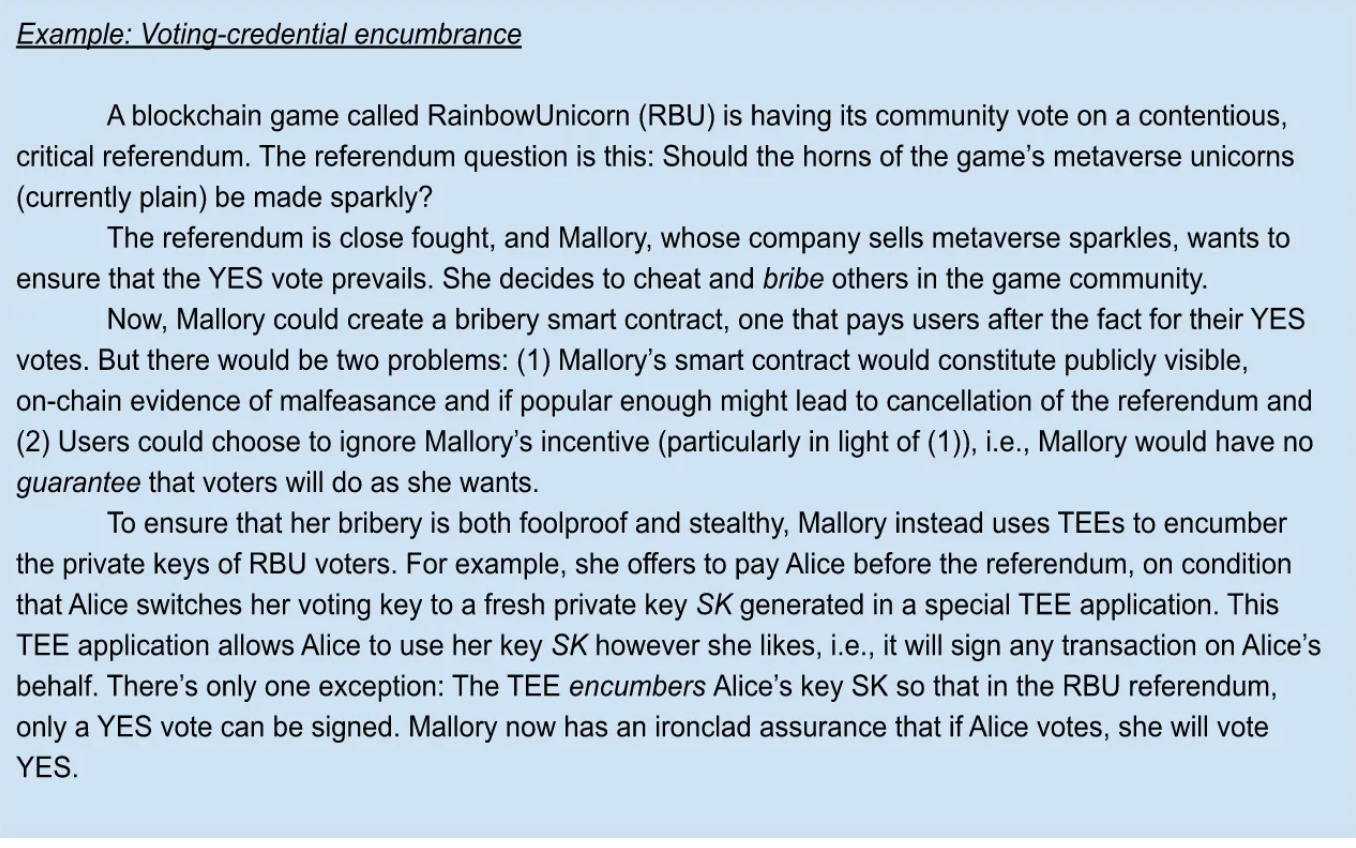
Bribery Attacks
This limitation in how standard proofs of knowledge are defined could leave voting protocols vulnerable to bribery attacks, Kelkar explains.
The absence of a central authority is a core principle of DAO governance. DAO members are typically token holders with voting rights over rules and decisions. In a bribery attack, however, a malicious actor can offer financial incentives to token holders through smart contracts, bribing participants to vote for a specific proposal or outcome.
"[..] A voting platform can be vulnerable to bribery attacks [...], where users can sell their votes to bribers in a dark market," Kelkar explains. "Our work attempts to establish that personal data ownership is truly in the hands of one person."
Proof of Complete Knowledge
An attacker could leverage a trusted execution environment (TEE) to ensure that token holders who accepted a bribe cannot vote freely. In such an environment, the attacker controls when and how the keys can be used.
The researchers identified two ways to enforce proof of complete knowledge. One approach involves using a TEE to prove that a voter owns a key and can use it — while also allowing the token holder to extract that key from the environment for free use whenever they choose.
In this way, token holders retain full control over their keys. Even if an attacker wants to lock down a key to control a voter, that key is already managed by the voting system's own TEE.
The second approach involves restricting keys using application-specific integrated circuits (ASICs) — the machines typically used in Bitcoin mining. By sending a key to an ASIC — which lacks a TEE environment — the key remains accessible to the user, ensuring they retain full control, while simultaneously proving that the key was used by the ASIC and preventing its use within a TEE.
The research is still at the prototype stage, according to Kelkar. "We demonstrate that this is a real threat to DAOs, and we prove it by introducing a practically deployable dark DAO that could easily purchase votes in existing DAOs today. This isn't something you can deploy right now, but it's nearly deployable as a research prototype today," Kelkar added.