Private Transactions Now Dominate Ethereum Order Flow: Report
Private transactions now dominate Ethereum's order flow as users look to protect their trades from frontrunners, according to an August 20 report from Blocknative. While private order flow still accounts for only about 30% of total Ethereum transactions, it consumes more than half of all gas used on the network, Blocknative said. This shift is creating "new centralization vectors as private transaction order flow is only accessible to permissioned network participants

Private transactions now dominate Ethereum's order flow as users look to protect their trades from frontrunners, according to an August 20 report from Blocknative.
While private order flow still accounts for only about 30% of total Ethereum transactions, it consumes more than half of all gas used on the network, Blocknative said. This shift is creating "new centralization vectors as private transaction order flow is only accessible to permissioned network participants," according to the report.
Private transactions involve sending transactions directly to a validator through a structure known as a "dark pool," rather than submitting them to the public queue. Public transactions are at risk of being frontrun by automated trading bots — a practice known as maximal extractable value (MEV).
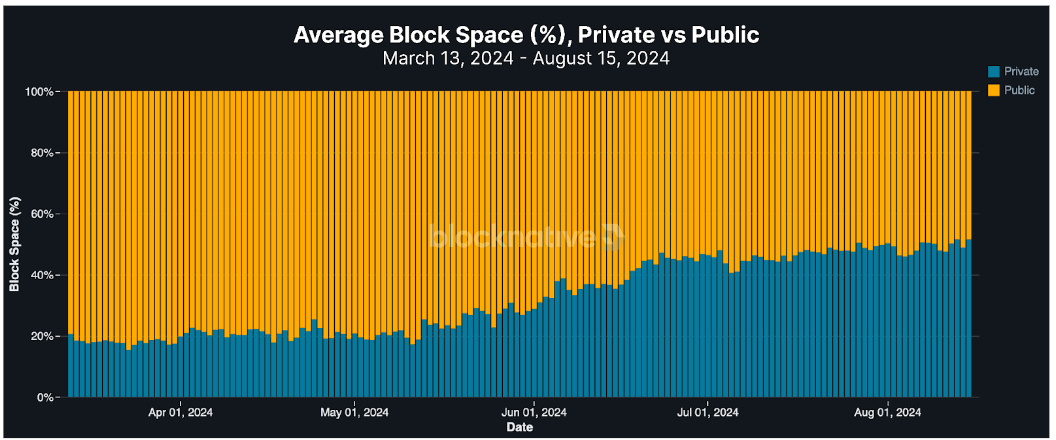
Private transactions consume over 50% of gas used on Ethereum. Source: Blocknative
According to Blocknative, "Users often opt to send transactions privately to protect against MEV, especially when executing complex on-chain actions — which use more gas — such as swap transactions." "This, in turn, uses more gas per transaction compared to non-MEV transactions."
Private order flow is currently dominated by a handful of block builders — namely Beaver, Titan, Rsync, and Flashbots — all of which "have seen significant increases in private order flow since March," according to Blocknative. Each of these block builders saw their gas consumption increase between 130% and 150% over that period, the report said.
The rise of dark pools has negative implications for users participating in the public transaction queue, including more volatile and unpredictable gas prices, according to Blocknative.
"There is reduced visibility into the gas fees needed to get a transaction executed on-chain when the majority of block space is consumed by privately submitted transactions," the report stated.
"This means there is an increased risk that you will price your transaction too low and end up with a stuck transaction, or overprice it to ensure your transaction gets executed on-chain," the report added.