South Korea to Pilot Blockchain Deposit Tokens for Government Spending Starting Q4 2026
South Korea's Ministry of Economy and Finance is partnering with 9 major banks to roll out a blockchain-based payment system that will replace traditional government procurement cards.
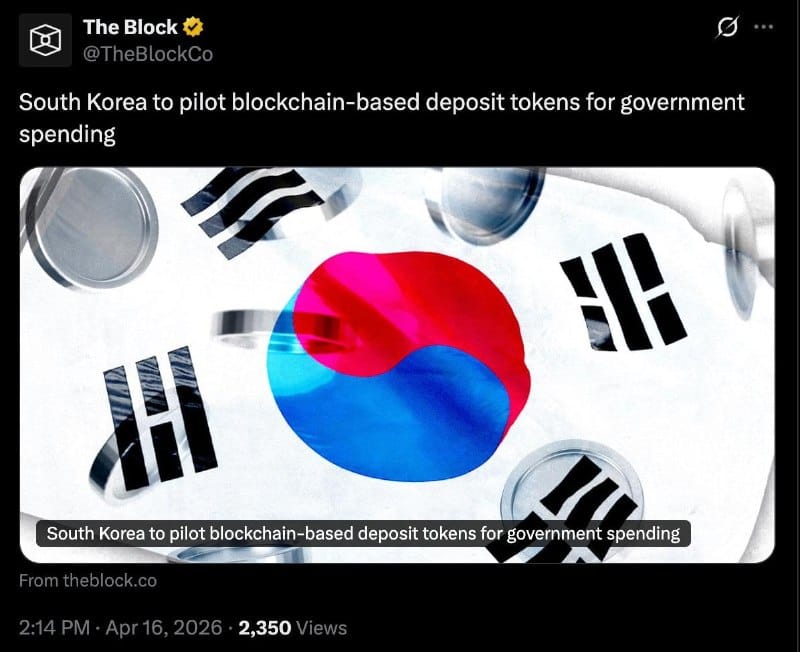
A Historic Pilot Program in Public Finance Management
South Korea is gearing up to launch one of the most ambitious experiments in applying blockchain technology to public financial management. According to CoinDesk, the Ministry of Economy and Finance (MOEF) will officially kick off a deposit token pilot program on a blockchain platform starting in Q4 2026.
What makes this initiative stand out is its scale. Rather than a small-scale experiment, the program will be deployed in Sejong City — South Korea's administrative capital — with the participation of the country's 9 largest banks. According to Crypto.news, confirmed participants include KB Kookmin, Shinhan, Woori, and Hana — four pillars of the South Korean banking system.
How Blockchain Deposit Tokens Work
Unlike typical tokens, the deposit tokens in this program remain formal liabilities of the issuing banks, recorded on a distributed ledger (DLT). MoneyCheck explains that these tokens will fully replace the traditional government procurement card system with programmable digital payments.
The key breakthrough here is the ability to pre-program spending limits. Each token can be configured in advance with a usage window and specific spending categories before funds are disbursed. This means that instead of reporting and justifying expenditures after the fact — as the old system required — government officials will only be able to spend within the approved purpose and timeframe.
The system is also integrated with dBrain, South Korea's existing digital budgeting and accounting platform. FXLeaders notes that this integration will create a complete audit trail for every won spent from the public budget.
Expected Benefits for Public Financial Management
In a statement quoted by Crypto.news, MOEF said the pilot "will serve as a basis for evaluating new payment and settlement methods, with the potential to impact national financial operations if the model proves effective."
The expected benefits include:
- Reduced misuse of public funds: Because spending purposes are pre-programmed, misappropriation becomes technically impossible
- Faster payment processing: Manual handling steps and paperwork are eliminated
- Lower transaction fees: Particularly meaningful for small-business vendors, as intermediary costs are cut out
- Greater transparency: Every transaction is immutably recorded on the blockchain
CoinCentral highlights that this is especially significant given South Korea's goal of digitizing 25% of all treasury disbursement transactions by 2030.
Context and Key Precedents
MOEF's deposit token program is not South Korea's first blockchain experiment in government. According to Crypto.news, in March 2026 the Ministry of Environment partnered with the Bank of Korea (BOK) on an earlier pilot, disbursing 30 billion won in subsidies for EV charging stations via deposit tokens.
MOEF's new pilot differs in scope and nature: rather than focusing on a single subsidy type, the new system will handle the full range of recurring operational expenses across government agencies — a much higher bar for technical and regulatory complexity.
The program was approved under the 2026 regulatory sandbox framework, which grants temporary exemptions from certain existing payment regulations to enable testing of new technology. Crypto Times calls this a bold move by South Korea to modernize public administration through technology.
Implications for the Global Digital Asset Market
South Korea's initiative carries significance beyond its own borders. This is one of the first large-scale, real-world applications of blockchain technology in public financial management, setting a precedent for other nations.
The program is running in parallel with South Korea's push to pass the Digital Asset Basic Act — comprehensive legislation covering stablecoins, tokenization, and cryptocurrency ETF plans. This signals Seoul's broader strategy to become a regional digital asset hub.
From a technical standpoint, the program's success could influence global Central Bank Digital Currency (CBDC) development trends. While deposit tokens are not CBDCs, the operational experience gained from running a national-scale blockchain payment system will provide invaluable lessons.
Challenges and Potential Risks
Despite the promising outlook, the program faces real hurdles. On the technical side, integrating 9 different banking systems onto a unified blockchain platform demands strict technical standards and high throughput capacity.
The regulatory challenges are equally complex. Deposit tokens remain bank liabilities yet operate on a blockchain — a legal gray area around liability, especially in the event of a technical failure or dispute.
Security is another top concern. The system will process public budget funds, making it a high-value target for cyberattacks. Securing a multi-bank blockchain payment network requires substantial investment in both technology and personnel.
Future Outlook and Expansion Model
If the Sejong City pilot succeeds, South Korea plans to roll the program out nationwide and raise the digitized transaction rate to 25% by 2030. That figure represents hundreds of trillions of won per year — a massive market for blockchain applications.
A successful pilot could also drive blockchain adoption across other public sector use cases, from tax administration and social welfare disbursements to public procurement. This would build out a complete public-sector blockchain ecosystem, positioning South Korea as one of the world's leading digital government pioneers.
On the technology side, lessons from this program will contribute to developing international standards for blockchain in the public sector. South Korea could emerge as a solutions provider and consultant for other countries looking to implement similar models.
Impact on Asia's Web3 Ecosystem
South Korea's deposit token program carries implications not just domestically but across Asia's Web3 ecosystem. A country with the 4th largest economy in Asia officially adopting blockchain for public financial management is likely to create a domino effect, encouraging nations like Japan, Singapore, and Thailand to explore similar initiatives.
This could also accelerate the growth of government-focused blockchain projects (GovTech) across the region. Startups and tech companies may find new opportunities building blockchain solutions for the public sector.
From an investment perspective, the program's success could boost institutional investor confidence in blockchain's real-world utility — not just in DeFi or NFTs, but in enterprise and government applications.
References
- CoinDesk — South Korea to pilot blockchain deposit tokens for government spending in Q4
- Crypto.news — South Korea to trial tokenized bank deposits for government operational spending
- CoinCentral — South Korea Launches Deposit Token Pilot to Replace Govt Cards
- Crypto Times — South Korea to use blockchain tokens for government-backed public spending
- MoneyCheck — South Korea pilots blockchain deposit tokens to modernize government payments
- FXLeaders — South Korea to pilot tokenized deposits for government spending in 2026 Sejong City trial
- Crypto.news — Bank of Korea launches phase 2 of digital won pilot with real subsidies