Study Suggests Bitcoin Mining Could Reduce Methane Emissions
According to a United Nations report, methane is "80 times more harmful than CO2 in the 20 years after it is emitted." A recent peer-reviewed scientific study titled "An Integrated Framework from Landfill Gas to Energy and Bitcoin Mining," published in the August 29 issue of the Journal of Cleaner Production, demonstrates how Bitcoin mining can reduce methane emissions. The study details how Bitcoin miners can leverage "Landfill Gas to Energy" systems to capture and convert methane from landfills into usable energy — retaining greenhouse gases and mitigating their harmful impact on the atmosphere.

According to a United Nations report, methane is "80 times more harmful than CO2 in the 20 years after it is emitted."
A recent peer-reviewed scientific study titled "An Integrated Framework from Landfill Gas to Energy and Bitcoin Mining," published in the August 29 issue of the Journal of Cleaner Production, demonstrates how Bitcoin mining can reduce methane emissions.
The study details how Bitcoin miners can leverage "Landfill Gas to Energy" (LFGTE) systems to capture and convert methane from landfills into usable energy — retaining greenhouse gases and mitigating their harmful impact on the atmosphere.
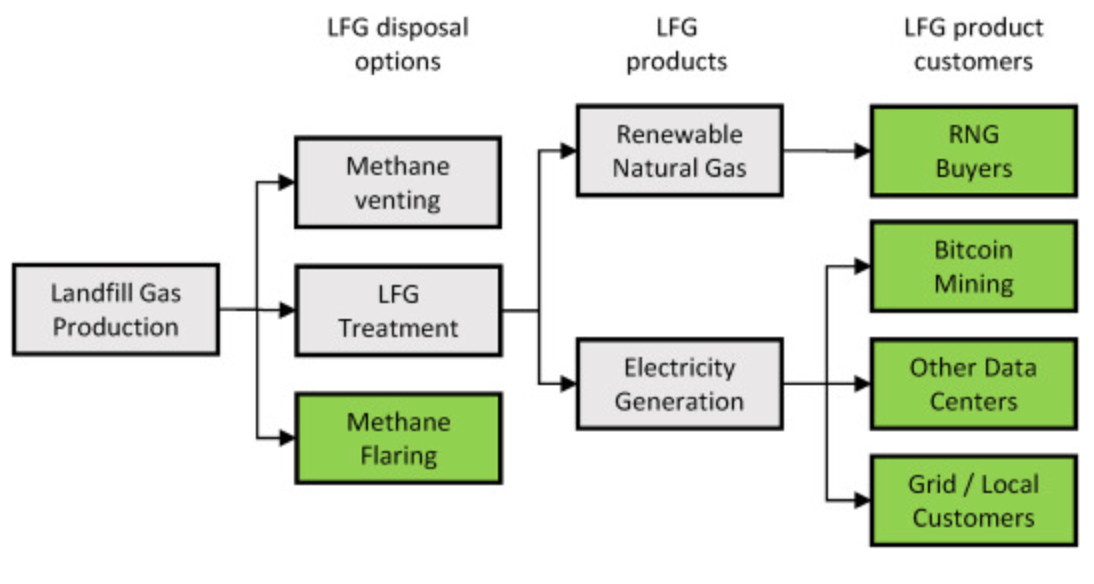
The study analyzes the energy chain from LFGTE. Source: Science Direct
The researchers argue that Bitcoin mining has an incentive structure well-suited for a project requiring large capital investment and long-term commitment — something other private enterprises lack due to the absence of a sustainable revenue generation and cost recovery strategy. According to the researchers:
"Bitcoin's economic incentives, available globally to miners anywhere, can provide an innovative solution to encourage methane emission reductions without relying on government incentives — a scalable and novel solution for rapid deployment."
The researchers also noted that this incentive structure is not limited to methane, and could be applied to repurpose other stranded energy sources, including "oil and gas flares, abandoned wells, wastewater treatment plants, farms, and agricultural processing operations."
Related: No More Range Anxiety: How DePIN Is Transforming the EV Charging Ecosystem
Marathon Digital Leverages LFGTE Systems
In 2023, MARA, formerly Marathon Digital, partnered with Nodal Power to mine Bitcoin using methane gas in Utah. When the 280-kilowatt initiative was first announced, MARA President and CEO Fred Thiel stated:
"At Marathon, we are always looking for innovative ways to diversify our operations, reduce energy costs, and leverage the unique aspects of Bitcoin mining to improve the environment in which we operate."
In May 2024, the company expanded on this mission by signing a contract with the Kenyan government to develop renewable energy infrastructure in the country.
Findings Corroborated by Other Research
The recent study published in the Journal of Cleaner Production is not the first to address the topic of Bitcoin miners reducing emissions by repurposing stranded energy sources.
In 2023, a study published by the Risk Management Institute found that Bitcoin mining operations could reduce global emissions by approximately 8% by 2030.